

Most of us do not lack information. We lack intention. The average day is filled with notifications, meetings, errands and endless scrolling, and by bedtime it is hard to say what actually mattered. Quest AI, a brand-new personal AI advisor that launched on Product Hunt on November 7, 2026 — and climbed to the #1 spot the same day — is built for exactly this problem. Instead of answering random questions like a general chatbot, it acts as a daily advisor that helps you live a more intentional life: clearer goals, better decisions, and days that actually match your priorities. That is what Quest AI for beginners is built to do.
In this beginner-friendly guide you will learn what Quest AI is, how to set it up, and how to use it step by step — from your first morning check-in to a weekly review that keeps you on track. No technical skills are needed. If you can describe what matters to you, you can use Quest. That is where Quest AI for beginners starts.
Step 1: Understand What Quest AI Actually Is
Quest AI is a personal AI advisor, not a general-purpose chatbot. A normal chatbot waits for a question and gives an answer. Quest is designed to know your goals, remember what you care about, and help you make choices that line up with the life you actually want — the “quest” in the name is deliberate: it treats your life like a journey with a direction, not a to-do list to survive.
Think of it as a thoughtful advisor who is always available. You can talk through a big decision, plan a difficult week, reflect on a bad day, or figure out what to focus on next. Because it remembers your intentions, its advice is personal instead of generic — it knows whether you are trying to get fit, grow a business, learn a skill, or simply slow down and be present. That is the core idea of Quest AI for beginners.
- Advisor, not answer machine: Quest helps you think, decide and plan — not just fetch facts.
- Intention first: everything starts from what you say matters, not from what is urgent.
- Daily companion: short check-ins in the morning and evening keep small choices aligned with big goals.
- Built for real life: work, health, money, relationships and learning all live in one place.
Quest launched on Product Hunt on November 7, 2026, and reached the #1 position on the launch feed the same day — a strong early signal that many people are looking for exactly this kind of help. Because it is brand new, features and pricing may still be evolving, so always check the official site for the latest details before you commit to a plan.
Step 2: Check If Quest AI Is Right for You
Quest is not for everyone, and knowing that before you start saves you time. It is built for people who want more direction, not more productivity hacks. If that sounds like you, Quest AI for beginners is a good fit.
- Great fit: you feel busy but not purposeful, you keep starting goals and dropping them, you want a second opinion before big decisions, or you want a simple daily habit of reflection.
- Good fit: students and professionals juggling many priorities, founders and freelancers who set their own schedules, and anyone building a new habit such as fitness, reading or learning a language.
- Not a fit: if you only need quick factual answers, a plain chatbot is faster; if you need therapy or medical advice, a qualified human professional is the right choice — Quest is an advisor, not a therapist.
If you run a small business, the same intentional approach applies to work: many founders use a digital agency for execution while an advisor like Quest helps them decide what is actually worth doing first. The tool helps you choose; people and agencies help you build.
Step 3: Create Your Account and Set Your First Intention
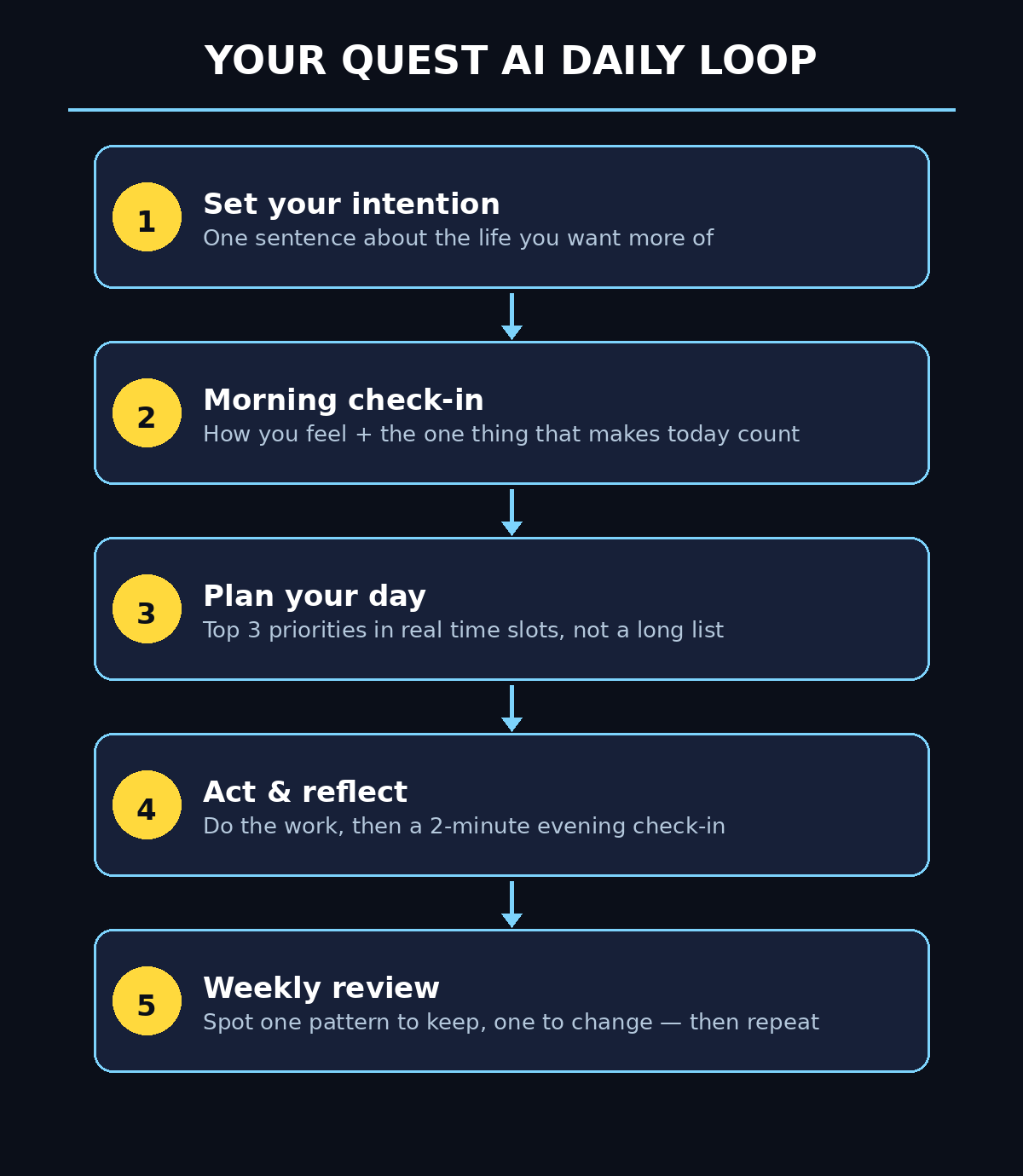
Getting started takes only a few minutes. Open the Quest website or app and create your account with an email address. Then, before touching any feature, do the one step that matters most: set your first intention. Setting it up this way makes Quest AI for beginners easy to stick with.
- Write one sentence about the life you want more of — for example, “I want calm, focused mornings” or “I want to grow my freelance income without burning out.”
- Pick one area to focus on first: health, work, money, relationships or learning. One area beats five vague ones.
- Choose a realistic time horizon: 30 days is long enough to matter and short enough to stay motivated.
- Write down what “done” looks like in plain words, so you and Quest can both recognise progress.
This intention becomes the compass for everything else. Every plan, reminder and review Quest gives you should point back to it. If your intention is vague, the advice will be vague too — so spend five honest minutes here.
Step 4: Tell Quest What Matters to You
After your first intention, give Quest the context it needs to advise you well. A personal advisor is only as good as what it knows about you, so answer its onboarding questions honestly and in plain language.
- Describe a typical day: when you wake up, when you work, when you have free time and when you usually feel drained.
- List your top three priorities right now, in order — the order matters more than the list.
- Mention the obstacles: the habits, people or situations that usually pull you off track.
- Share what has worked for you before. If morning workouts failed but evening walks stuck, say so.
- Set your boundaries: what you will not sacrifice — sleep, family time, prayer, or a hobby — even on busy days.
Do not worry about writing perfectly. Short, honest sentences work better than polished paragraphs. You can update this context any time your life changes, and you should — an advisor working from last year’s priorities gives last year’s advice.
Step 5: Start Your Morning Check-In
The morning check-in is the heart of Quest. It takes two to three minutes and turns a reactive day into an intentional one. A short check-in like this is Quest AI for beginners at its best.
- Open Quest first thing — before email and social media, if you can.
- Answer three quick prompts: how did you sleep, how do you feel, and what is the one thing that would make today count?
- Let Quest suggest your top three priorities for the day, based on your intention and your calendar.
- Ask it to flag anything that conflicts with your intention — a meeting that eats your focus time, or a task you keep postponing for a reason.
- End the check-in by naming your single most important task. One clear priority beats a list of twelve.
The magic is not the questions; it is the repetition. After a week of morning check-ins you will start noticing patterns — which days feel good, what drains you, and which small choices keep showing up. If you want to go deeper on planning your workdays, the team behind AI automation services often talks about the same principle: a short planning ritual beats a long productivity system every time.
Step 6: Use Quest as a Decision Advisor
Most bad decisions are not made from bad information — they are made in a rush, under pressure, or to please someone else. This is where Quest earns its keep as an advisor.
- Bring the decision to Quest in plain words: “Should I take this freelance project?” or “Should I move my workout to the evening?”
- Ask it to list the trade-offs: what you gain, what you lose, and what each option costs in time, money or energy.
- Ask the “intention test”: which option moves you closer to the intention you set in Step 3?
- Ask for the second-order effects: what happens next week, next month, if you choose this?
- Ask what information you are missing, and whether the decision is reversible — reversible decisions deserve speed, irreversible ones deserve patience.
Quest will not make the decision for you, and it should not. Its job is to slow you down just enough to think clearly, then let you choose with your eyes open. For genuinely big life decisions — changing careers, moving cities, major money choices — use Quest to prepare your thinking, then talk it through with a trusted human too.
Step 7: Plan Your Day Around Your Intentions
Once the morning check-in is done, use Quest to turn your priorities into a realistic plan. A plan that ignores your real schedule is a fantasy, so keep it honest.
- Block your most important task into a real time slot, not a vague “sometime today”.
- Ask Quest to help you say no: which meeting, message or task can be declined, delayed or delegated today?
- Build in recovery: short breaks, a walk, and a proper lunch — an intentional life is not a non-stop life.
- Prepare for the hard part of the day in advance: if afternoons are your weak point, plan the easiest valuable task for then.
- Keep the plan short. Three meaningful blocks plus the essentials will beat a colour-coded schedule you abandon by noon.
At the end of the day, do a two-minute evening check-in: what got done, what did not, and why. This is not a guilt exercise — it is data. Over time, Quest can spot the patterns you cannot see yourself, like the fact that your best days always start with a walk, or that late meetings always wreck the next morning.
Step 8: Build Habits That Actually Stick
Intentions fail when they depend on willpower alone. Quest helps you turn an intention into a small, repeatable habit — the kind that survives a bad week. Small prompts like these are what make Quest AI for beginners work day after day.
- Shrink the habit until it feels almost too easy: read two pages, walk ten minutes, write one paragraph.
- Attach it to something you already do: after coffee, after lunch, right after you close your laptop.
- Ask Quest to remind you at the right moment, not just at a fixed time — context beats the clock.
- Track the streak, but protect it gently: one missed day is an accident, two is the start of a new pattern. Quest can help you restart without the guilt spiral.
- Review each habit monthly: keep what is working, change what is not, and drop what no longer serves your intention.
Most habit apps count days. A personal advisor asks a better question: is this habit still moving you toward the life you want? If the answer is no, changing the habit is progress, not failure.
Step 9: Do a Weekly Review With Quest
The weekly review is where Quest pays for itself. Set aside fifteen to twenty minutes once a week — Sunday evening works well for most people — and walk through the week together.
- Ask Quest to summarise the week: what you completed, what slipped, and how your energy and mood tracked.
- Look for one pattern worth keeping and one worth changing. Fixing one thing per week compounds fast.
- Review your intention: is it still the right one, or has life changed? Updating an intention is allowed.
- Plan the next week loosely: the three priorities, the one difficult conversation, and the one thing you are looking forward to.
- Celebrate one win, however small. Intentional living includes noticing what went right.
People who do a weekly review get dramatically more value from an advisor like Quest than people who only open it when they are stuck. The review turns scattered days into a story you can steer.
Step 10: Avoid the Common Beginner Mistakes
New users usually make the same few mistakes with a personal AI advisor. Avoid them and you will get more from Quest in the first month than most people get in six.
- Setting five intentions at once: start with one. You can add more once the first one is a habit.
- Treating Quest like a search engine: quick factual questions waste its strength. Bring it decisions, plans and reflections instead.
- Hiding the truth: if you skip workouts or overspend, say so. An advisor working from a polished story gives polished, useless advice.
- Checking in only when things go wrong: the daily two-minute check-in is what makes the hard days easier.
- Expecting overnight change: intentional living is a direction, not a switch. Judge Quest after thirty days, not three.
- Ignoring privacy: you are sharing personal context, so read the privacy policy, know what data is stored, and keep truly sensitive details out of any AI tool.
Quest AI vs Other Options: A Quick Comparison
Quest is not the only way to live more intentionally. Here is how it compares with the tools people usually reach for instead.
| Option | Best For | Personal Advice | Daily Guidance | Effort Needed |
|---|---|---|---|---|
| Quest AI | Living intentionally, decisions, daily planning | Yes — based on your goals | Yes — morning and evening check-ins | Low — a few minutes a day |
| General AI chatbot | Quick answers and writing help | Generic — no memory of your goals | No — only when you ask | Low |
| Habit tracker app | Counting streaks | No — it only records | Reminders only | Low |
| Paper journal | Deep reflection | No — you advise yourself | No — self-directed | Medium |
| Human coach | Deep personal change | Yes — and accountability | Usually weekly sessions | High — and expensive |
Quest sits in the middle: more personal than a chatbot, more guided than a journal, and far cheaper and more available than a human coach. For many beginners, that middle ground is exactly right. And if you later want a human coach for a specific goal, Quest’s weekly summaries make a great briefing for them.
Frequently Asked Questions
Is Quest AI free to use?
Quest launched on Product Hunt on November 7, 2026, and is brand new, so its pricing may still be evolving. Check the official Quest website for the current plan and any free tier before you sign up — new tools often launch with generous early pricing that changes later.
What is Quest AI actually for?
Quest is a personal AI advisor that helps you live a more intentional life. It helps you set intentions, plan your days around them, make better decisions, build habits and review your week — all based on what you say matters to you.
Is Quest AI better than ChatGPT for planning my life?
For life planning, yes — that is what it is built for. A general chatbot answers questions well but does not remember your goals or guide you daily. Quest is designed around your intentions, with morning check-ins, decision help and weekly reviews built in.
Do I need any technical skills to use Quest AI?
No. You only need to describe your goals and your day in plain language. If you can write a message to a friend, you can use Quest.
Is my personal information safe with Quest AI?
You are sharing personal goals and daily details, so read the privacy policy before you start, check what data is stored, and avoid entering highly sensitive information such as passwords, financial account details or medical records into any AI tool.
Can Quest AI replace a life coach or therapist?
No. Quest is an advisor for everyday decisions, planning and habits. A human coach or therapist brings experience, accountability and judgement that no AI can replace — and for mental health concerns, a qualified professional is always the right choice.
Final Thoughts
Quest AI arrived at the right moment. We have more tools than ever and less direction than ever, and a personal AI advisor that asks “what matters to you?” before “what do you need done?” is a genuinely useful idea. It hit #1 on Product Hunt on launch day because that question resonates — most of us are busy, but not many of us are intentional.
Start small: one intention, one morning check-in, one weekly review. Give it thirty days and judge it by a simple test — do your days look more like the life you want than they did a month ago? If the answer is yes, Quest has done its job. And if you want to sharpen the tools around your work too, explore the free AI tools below — small upgrades compound, just like small intentions do.
Explore More Free AI Tools
Want more free AI helpers? Try the AI Title Generator, Meta Description Generator, AI Rewriter and Keyword Density Checker on AI Tool Steps — free tools that make your content and your workday a little easier. That is the simplest way to start with Quest AI for beginners.