

Insurance shopping has a reputation problem. It usually means long forms, confusing jargon, and a phone call you did not want to make, followed by a quote that still does not explain what you are actually paying for. Luva AI was built to change that experience completely. Launched on October 27, 2026, Luva is the first insurance comparison platform designed from day one around a conversational AI experience, with live rates from many trusted carriers and real-time quotes you can act on.
At the centre of the experience is Lu, an AI-powered insurance guide. Instead of filling in form after form, you simply describe your situation in your own words. Lu asks only the questions it needs to give you a quote, explains why each piece of information matters, and shows you how different coverage choices change the price. You can adjust your coverage and watch the pricing update instantly, then buy online or connect with a licensed agent when you want a human to help.
In this beginner guide, you will learn how to use Luva AI from scratch: what Lu actually does, how to start your first conversation, what information to have ready, how to read and compare quotes without getting lost, and how to finish with a purchase or an agent conversation you feel good about. You do not need any insurance knowledge to start. If you can describe your car, your home, or your family situation in plain language, you can use Luva.
Step 1: Understand What Luva AI Actually Is
Luva AI is not another quoting tool with a chatbot layered on top. That distinction matters, because it changes how you should use it. Traditional comparison sites ask you the same long list of questions whether the answers matter for your quote or not. Luva starts with a conversation, and Lu asks only what it needs for the specific coverage you are shopping for.
Think of Lu as a knowledgeable friend who happens to know insurance. You say something like, “I just bought a used car and I need insurance before Friday,” and Lu works out what to ask next. It explains its questions as it goes, so you are not left wondering why your driving history or your home’s roof age suddenly matters. That explanation is the point: Luva wants you to understand your options, not just receive a number.
The platform then shows live rates from many trusted carriers side by side. You are not locked into one company’s view of the world. You can see how the same coverage looks at different prices, and you can change a detail — a higher deductible, for example — and see the price move straight away. That instant feedback turns insurance from a guessing game into a decision you can actually follow.
Step 2: Decide What You Want to Compare With Luva AI Before You Start
Lu will guide you, but five minutes of thinking first makes your first conversation much smoother. Before you open Luva, decide which kind of cover you are shopping for and what matters most to you. Is the lowest monthly price the priority, or would you rather pay a little more for a lower deductible if something goes wrong?
Write down a short list before you start:
- The type of insurance you need, such as auto, home, or renters cover
- The item being covered, such as your car’s make, model, and year
- Who needs to be covered, such as yourself, a partner, or family drivers
- Your current cover, if you have any, and when it renews
- Your rough budget range and the deductible you could afford
You do not need exact figures for everything. Lu is designed to work with everyday language, and it will ask for specifics only where they change your quote. Having the basics ready simply stops you from pausing mid-conversation to hunt for documents. It also helps you spot a quote that looks wrong, because you already know what you asked for.
Step 3: Start a Conversation With Lu in Plain Language
Starting is the easiest part, and it is deliberately unlike a traditional insurance form. Open Luva and begin a conversation with Lu. Describe your situation the way you would describe it to a friend. There is no special vocabulary to learn and no perfect first sentence to get right.
Good opening messages sound like real life:
- “I need car insurance for a 2021 Honda Civic I just bought.”
- “My home insurance renews next month and I think I am paying too much.”
- “I am renting my first apartment and my landlord wants proof of renters insurance.”
Lu will respond with the next question, and only the next question. Answer honestly and plainly. If you are unsure about something, say so — Lu can explain what the term means or why it matters before you answer. That back-and-forth is the whole advantage of a conversational guide: you learn as you go, instead of guessing at a form field and hoping you guessed right.
Step 4: Answer Only What Lu Asks, and Ask Questions Back
One of the best habits for beginners is to treat the conversation as two-way. Lu asks you questions, but you can also ask Lu questions at any point. If a term confuses you, ask what it means. If two quotes look almost identical, ask what is actually different between them. If a price jumps after you change one detail, ask why.
This matters because insurance quotes are only as good as the information behind them. A small mistake — the wrong garaging address, a missed safety feature, an old accident you forgot — can change your price or even your cover later. Lu explains why information matters precisely so you can give accurate answers instead of rushed ones.
Take your time here. There is no timer running, and no salesperson waiting on the line. If you need to check a document, tell Lu you will come back to that question. A careful ten minutes now is worth far more than a fast quote that does not match your real situation. The same careful habit helps with any AI tool you use for money decisions: slow down where the details matter, and let the AI explain itself.
Step 5: Read Your Luva AI Live Quotes Like a Comparison, Not a Single Number
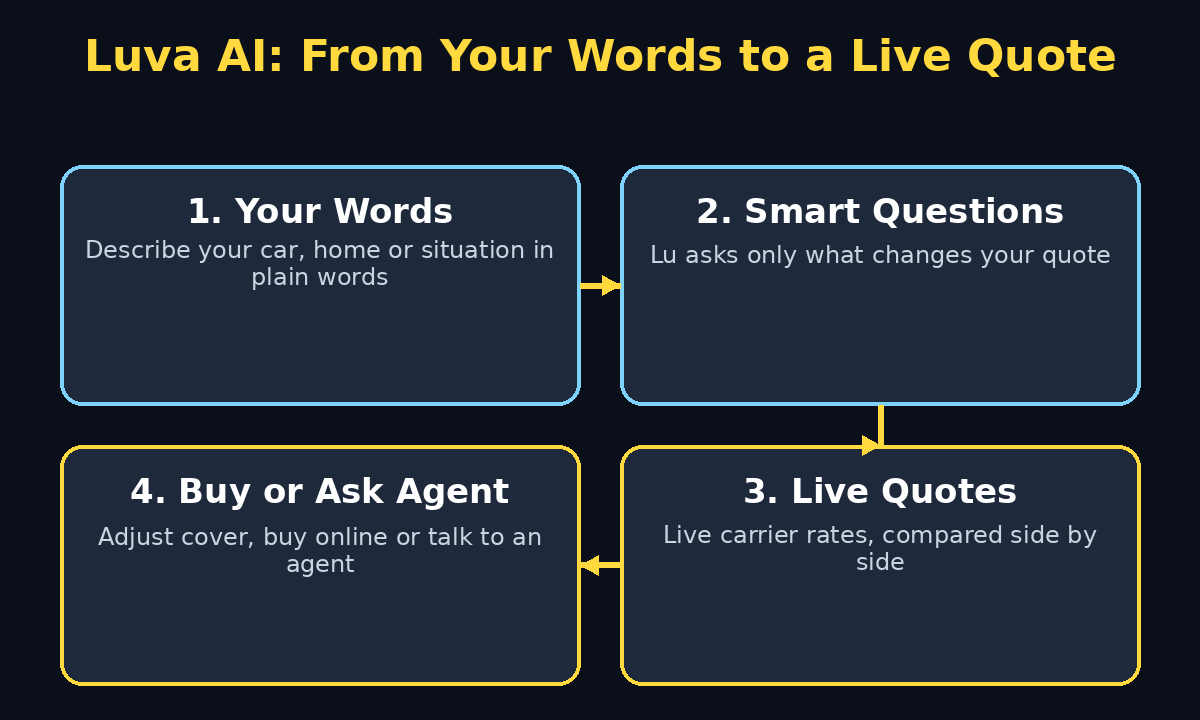
When Lu has enough information, you will see live quotes from multiple carriers. This is where most beginners make their first mistake: they pick the cheapest number and stop. A quote is not just a price. It is a price for a specific package of cover, and two packages at similar prices can be very different underneath.
Look at each quote as a small bundle and compare the same things across carriers:
- The monthly or annual premium, and what payment options are offered
- The deductible you would pay before cover kicks in after a claim
- The cover limits, meaning the maximum the policy pays out
- Any extras included, such as roadside help or rental cover
- Exclusions or conditions that would surprise you later
Luva’s conversational design helps here, because you can ask Lu to explain a difference in plain words rather than decoding policy language yourself. Try asking, “Why is this one cheaper than that one?” or “What would I lose if I picked the cheapest option?” The answers usually point to a deductible, a limit, or an extra that explains the gap. Once you see that, you are comparing properly.
Step 6: Adjust Your Coverage and Watch the Price Move Instantly
This is the step that makes Luva feel different from every form you have filled in before. Change a coverage choice, and the pricing updates instantly. You can test trade-offs in real time instead of imagining them or re-running a whole application.
Try a few experiments before you decide:
- Raise the deductible and see how much the premium falls
- Lower a cover limit and check whether the saving is worth the risk
- Add an extra, such as rental reimbursement, and see what it actually costs
- Change a payment plan and compare monthly versus annual totals
Each experiment teaches you something about your own priorities. Some people discover that a slightly higher deductible saves a meaningful amount each month, and they are comfortable with that risk. Others realise they would rather pay a little more for peace of mind. Neither choice is wrong. The point is that you are choosing with real numbers in front of you, not with a guess.
If a change produces a surprising result, ask Lu why. Sometimes a single detail — a safety feature, a claims history item, a garaging location — has a bigger effect than you expect. Understanding that effect now prevents an unpleasant surprise later, when you actually need to claim.
Step 7: Check the Fine Print Before You Fall in Love With a Quote
A live quote is a strong signal, not a final contract. Before you buy anything, read the key terms of the quote you are leaning towards. You do not need to read every page like a lawyer, but you should check the handful of things that decide whether a policy is right for you.
Work through this short checklist:
- The names, vehicles, or property listed are exactly right
- The cover limits match what you thought you were buying
- The deductible is an amount you could actually pay after an incident
- The start date gives you continuous cover with no gap
- Any discount shown is one you genuinely qualify for
If anything looks wrong, go back to Lu and fix it in the conversation. It is much easier to correct a detail before purchase than after. If Lu’s explanation of a term still feels unclear, that is a good moment to use the licensed-agent option: a human can walk through the wording with you before you commit. Good comparison tools make buying easy, but they should never make you feel rushed past the details.
Step 8: Buy Online or Talk to a Licensed Agent
When you are happy with a quote, Luva gives you two honest ways to finish. You can purchase online and complete the process in the same conversation flow, or you can connect with a licensed agent for a human conversation before you buy. Pick the route that matches your confidence level, not the one that feels fastest.
Buying online suits straightforward situations: the details are correct, you understand the cover, and you are comfortable with the price and deductible. Keep a copy of the confirmation and the policy documents, and check that the start date and the covered items are exactly as you expect. Set a reminder to review the policy at renewal, because prices and needs both change over time.
Talking to an agent suits anything complicated: a recent claim, a new driver in the household, a home with unusual features, or simply a quote you do not fully understand yet. An agent can confirm details, explain wording, and check for discounts you might have missed. There is no penalty for asking. In fact, using both — Lu for fast comparison, then an agent for a final check — is often the smartest beginner move of all.
For a business owner, the same compare-then-confirm habit works beyond personal insurance. When a small business compares tools or services, a quick look at how a professional presents its own services can show what clear, honest pricing pages look like, and that standard is worth holding every comparison tool to.
Step 9: Save Your Conversation and Set a Renewal Review
Insurance is not a one-time purchase. The best price today may not be the best price at renewal, and your life will change in ways that change your cover needs. Luva’s conversational format makes this easier, because your conversation is a record of what you asked for and why.
After you buy, do three small things:
- Save or screenshot your final quote summary and policy start date
- Note the renewal date in your calendar with a reminder two weeks early
- Write down the one trade-off you chose, such as a higher deductible for a lower premium
At renewal, start a fresh conversation with Lu and compare again. Prices move, carriers change their appetite for certain risks, and a new driver, a new car, or a move can all shift the best option. A fifteen-minute annual check is one of the highest-value habits in personal finance, and it costs nothing but attention. If your situation has changed a lot, mention it early in the conversation so Lu asks the right new questions.
The same review habit applies to the wider world of AI tools. New platforms launch every week, and the tool that was best last year is not always best now. Teams that build review their stack on a schedule for exactly this reason: regular, small comparisons beat one big, rushed decision.
Step 10: Compare Luva With Traditional Insurance Shopping
Luva is a genuinely new way to shop, but a beginner should still know how it stacks up against the old ways before relying on it for an important purchase. The table below compares the approaches honestly, based on what each is known for at launch.
|—|—|—|—|—|—|
| Shopping method | How it works | Speed | Explains itself? | Best for | Watch out for |
| Luva AI | Conversational guide asks only what it needs, live carrier rates | Fast, instant price updates | Yes, Lu explains each question and price change | Beginners who want guidance and comparison in one place | Always verify final policy terms before buying |
| Traditional comparison site | Long fixed form, then a list of quotes | Medium | Rarely, you decode the differences yourself | Shoppers who already know insurance terms | Easy to pick on price alone and miss cover gaps |
| Single insurer website | One company’s form and one price | Medium | Sometimes, within that company’s products | Loyal customers happy with one carrier | No comparison, so you never know the market price |
| Phone agent or broker | Human conversation, quotes gathered for you | Slowest | Yes, a person explains everything | Complex situations and nervous first-time buyers | Depends on the agent’s range of carriers |
The honest verdict: if insurance jargon has ever put you off comparing, Luva is the friendliest starting point available at launch. If your situation is complex, pair it with a licensed agent for the final check. Either way, you end up better informed than a shopper who simply renews the same policy year after year without ever seeing what else is out there.
Frequently Asked Questions About Luva AI
What is Luva AI in simple words?
Luva AI is a conversational insurance comparison platform launched on October 27, 2026. You chat with Lu, its AI-powered insurance guide, describe your situation in plain language, and get live quotes from multiple trusted carriers that you can compare and adjust in real time.
Is Luva AI really free to start comparing?
Starting a conversation with Lu and comparing live quotes costs nothing to begin. You only pay when you actually buy a policy, and then you pay the carrier’s premium for the cover you chose. Always check the final policy price before purchase, since a comparison quote and a final bound price can differ if details change.
Do I need to know insurance terms to use Luva?
No. That is the point of the conversational design. Lu asks only the questions it needs, explains why each one matters, and answers your questions in plain language. If a term confuses you, ask Lu what it means before you answer.
Can I buy insurance directly through Luva, or do I need an agent?
Both. You can purchase online through Luva once you are happy with a quote, or you can connect with a licensed agent for a human conversation before you buy. The agent route is a good choice for complex situations or any quote you do not fully understand yet.
Which carriers does Luva compare?
Luva displays live rates from many trusted carriers, according to its launch announcement. The exact carriers available can vary by location and coverage type, so the quotes you see in your conversation are the reliable guide for your area, not a fixed national list.
Is Luva AI safe for sharing personal information?
Luva needs personal details to produce accurate quotes, such as your vehicle or property information, so share only what the conversation genuinely needs for a quote. Never share passwords, bank login details, or ID numbers in any AI chat. Check Luva’s privacy terms before you start, and use the licensed-agent route if you prefer a human handling sensitive details.
Final Thoughts
Luva AI does not make insurance exciting, and it does not need to. Its promise is quieter and more useful: a conversation instead of a form, an explanation instead of a mystery number, and live comparison instead of loyalty to one carrier by default. For a beginner, that combination removes the biggest barrier to shopping around, which was never the price — it was the confusion.
Start today with the five minutes of preparation in Step 2, describe your situation to Lu in your own words, and test a few coverage trade-offs before you decide. Check the fine print, use a licensed agent when the situation is complex, and set a renewal reminder so next year’s decision is just as informed as this one. Insurance bought with understanding is worth more than insurance bought in a hurry, whatever the monthly number says.
Explore More Free AI Tools
If you enjoyed comparing with Luva AI, keep exploring free tools on AIToolSteps: try our AI Title Generator for headlines that get clicks, our Meta Description Generator for search snippets, our AI Rewriter for polishing rough drafts, and our Keyword Density Checker for on-page SEO — all free at https://aitoolsteps.com/.