
People are asking ChatGPT and Perplexity for product recommendations instead of scrolling through Google results. If your brand is never mentioned in those AI answers, a whole stream of potential customers simply never hears about you. That is where ReSO AI comes in.
ReSO AI is a brand-visibility platform built for the age of AI search. It shows you how often tools like ChatGPT, Perplexity, and Google AI Overviews mention your brand, compares you with competitors, and tells you exactly what content to create so AI engines start citing you. The best part for beginners: the free tier includes a one-off baseline report, so you can discover whether you even have a visibility problem before spending a single rupee.
In this beginner-friendly guide, you will learn what ReSO AI does, how to sign up, how to run your first visibility audit, and how to turn the results into a simple plan that gets your brand recommended by AI assistants.
What Is ReSO AI and Why Does It Matter in 2026?
ReSO AI is a software platform that helps brands optimize their visibility inside AI-generated answers. Traditional SEO tools show you how you rank on Google result pages. ReSO AI goes one step further: it measures how often AI engines like ChatGPT, Perplexity, and Google AI Overviews name, link, or recommend your brand when buyers ask questions in your market.
This new discipline is often called GEO (Generative Engine Optimization) or AEO (Answer Engine Optimization). ReSO AI essentially bridges traditional SEO and AI-driven discovery, making sure your business gets referenced in the answers people actually read.
Why does this matter? Because search behavior is shifting fast:
- Millions of people now ask AI assistants for buying advice directly — “what is the best email marketing tool for a small bakery?”
- AI answers synthesize information from multiple sources and name only a few winners. If your brand is not cited, you are invisible in that conversation.
- Being cited by AI engines sends real referral traffic. Some ReSO AI clients report month-on-month citation growth of 38% and measurable lifts in traffic from LLM-driven search.
For a small business owner, blogger, or freelancer, this is a huge opportunity. The field is new, the competition is low, and free tools like ReSO AI’s baseline report let you check your standing in minutes.
Step 1: Understand What AI Visibility Really Means
Before touching the tool, get the core idea straight. AI visibility answers one question: when buyers ask AI engines about your market, how often is YOUR brand the one that gets mentioned?
Traditional SEO measures rankings on a results page with ten blue links. AI search is different:
- There is no page one or page two — there is a single answer, and it names only a handful of brands.
- The AI builds its answer from sources it trusts and can clearly identify, which rewards clear, structured, quotable content.
- Your share of answers can be measured like a market share — for example, 41 out of 480 AI answers naming your brand means an 8.5% visibility score.
ReSO AI tracks this across the buyer journey, not just one question. It checks discovery questions (“what tools exist for X?”), comparison questions (“X vs Y for small teams”), persona-fit questions, and pricing questions — the full funnel, mapped through real buyer prompts.
Step 2: Learn How AI Engines Choose Which Brands to Mention
AI assistants do not pick brands at random. Understanding their habits helps you interpret your ReSO AI report later:
- Cited, trustworthy sources win. Perplexity always cites its sources, and ChatGPT’s search mode does too. Pages with clear facts, structured data, and quotable statements get cited more.
- Entity clarity matters. AI engines need to know exactly what your brand is, what it does, and who it is for. Vague homepages confuse them.
- Fresh, specific content beats generic pages. A detailed guide answering a specific buyer question is far more citable than a thin product page.
- Consistency across the web helps. When multiple quality sources describe your brand the same way, AI engines trust that description.
This is why ReSO AI’s approach combines content analysis with technical SEO and entity signals — it is not just counting mentions, it is diagnosing WHY some brands get mentioned and others do not.
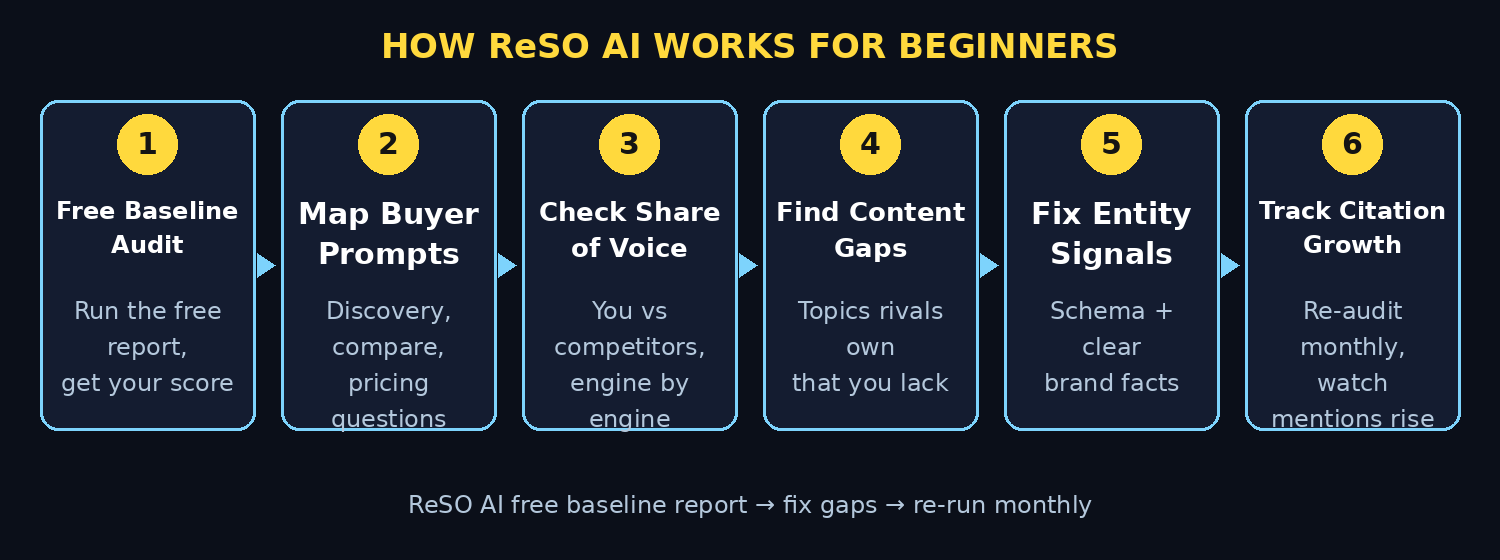
Step 3: Sign Up for ReSO AI’s Free Tier and Run Your Baseline Report
ReSO AI’s free tier is the perfect starting point. Here is how to begin:
- Go to the ReSO AI website and create a free account.
- Enter your brand name and website domain.
- Run the free one-off baseline report. This is the honest entry point — it shows you whether you have a visibility problem before you consider any paid plan.
- Wait for the audit to collect answers across the AI engines.
The baseline report measures your share of answers against competitors across a set of buyer prompts. It gives you a clear, honest number: this is how often AI engines mention you right now. No demo call, no sales pitch — just your data.
Think of this like a health checkup. You would not start a diet without weighing yourself first, and you should not start an AI-visibility strategy without knowing your starting score.
Step 4: Add Your Brand, Domain, and Competitors Correctly
Accurate setup is what separates a useful audit from a misleading one:
- Use your exact brand name as customers know it — the same spelling that appears on your website and social profiles.
- Add your real domain so the tool can analyze your existing content and technical setup.
- List your true competitors — the 3 to 5 brands buyers genuinely compare you against, not just the famous ones in your industry. AI engines answer comparison questions, so your real comparison set matters most.
- Define your market simply. If you sell handmade candles, your market is “handmade scented candles,” not “e-commerce” or “retail.”
Small businesses often skip this step and track the wrong keywords. A digital agency like D365A can help you turn these insights into a focused content plan if you want expert help, but the ReSO AI setup itself is simple enough for any beginner.
Step 5: Map Your Buyer Prompts (Not Just Keywords)
This is where ReSO AI differs from old-school SEO tools. Instead of tracking keywords, it uses intent-driven prompt mapping — analyzing real buyer prompts structured around what buyers actually ask.
Set up prompts across the buyer journey:
- Discovery prompts: “What are the best project management tools for freelancers?”
- Comparison prompts: “Asana vs Monday for a team of five — which is better?”
- Persona-fit prompts: “What CRM is easiest for a non-technical founder?”
- Pricing prompts: “Affordable alternatives to Salesforce for startups”
ReSO AI models dozens of variables tied to search intent, so each prompt represents a realistic buyer moment. As a beginner, start with 5 to 10 prompts covering the stages above. Quality of prompts beats quantity — each one should mirror a question a real customer has actually asked you.
Pro tip: Check your support emails, DMs, and FAQ page. The exact questions customers ask you in plain language make the best buyer prompts, because they match how people talk to AI assistants.
Step 6: Read Your Share-of-Voice and Visibility Report
Once the audit finishes, you will see your visibility score — essentially your share of AI answers about your market. Here is how to read it like a pro:
- Your visibility score: The percentage of AI answers that name or link your brand (for example, 8.5% from 41 of 480 answers). This is your headline number.
- Competitor comparison: Which brands AI cites instead of you, and how often. This list is gold — it shows exactly who is winning the AI conversation.
- Engine-by-engine breakdown: How you perform on ChatGPT vs Perplexity vs Google AI Overviews separately. You might dominate Perplexity but be invisible in ChatGPT answers, which tells you where to focus.
- Buyer-stage gaps: Where in the journey you disappear — maybe buyers discover competitors first, or you lose at the pricing-comparison stage.
Do not panic at a low first score. Most small brands score near zero on their first audit. That is normal — and it means every improvement you make will be clearly visible in the next audit.
Step 7: Find Your Content Gaps Against Cited Competitors
ReSO AI’s content and gap analysis compares your existing content against the sources AI platforms commonly cite in your category. This is the most actionable part of the report:
- See which competitor pages get cited for your buyer prompts. Open them and study their structure: clear headings, direct answers, comparison tables, fresh data.
- Spot the topics you have not covered. If competitors have a “best tools for X” guide or a pricing comparison page and you do not, that is a gap you can close.
- Check content freshness. AI engines favor recently updated content. A competitor page updated last month often beats your two-year-old guide.
- Note the formats that win. Listicles, comparison tables, FAQ sections, and step-by-step guides are the formats AI engines quote most easily.
Make a simple list of your top 5 gaps, ranked by how often the missing topic appears in buyer prompts. This list becomes your content calendar.
Step 8: Fix Technical SEO and Entity Signals on Your Site
Content alone is not enough. ReSO AI also surfaces technical and entity improvements that make your site more legible to AI engines:
- Structured data: Add schema markup (FAQ, Product, Review, Organization) so AI engines can parse your facts cleanly.
- Entity consistency: Make sure your brand name, description, and offerings read the same on your homepage, About page, social profiles, and business listings. Conflicting descriptions confuse AI models.
- Clear, quotable statements: Write short, factual sentences AI can lift directly — “ReSO AI tracks brand mentions across ChatGPT, Perplexity, and Google AI Overviews” is a citable fact; “We are passionate about excellence” is not.
- Fast, accessible pages: AI crawlers, like human readers, prefer sites that load fast and work on mobile.
Teams exploring AI automation services, such as those offered by Agentic Affairs, often bundle these technical fixes with content work — but a beginner can start with free schema generators and a careful About page rewrite.
Step 9: Create Citation-Friendly Content That AI Engines Love
Now turn your gap list into content. ReSO AI’s AI-powered content strategy support helps you create formats designed to increase your citation chances:
- Answer the question in the first 50 words. AI engines quote pages that give direct answers fast, then expand with detail.
- Use comparison tables. “Tool A vs Tool B” tables are among the most cited formats because AI can summarize them in one sentence.
- Add FAQ sections. Each question-answer pair is a ready-made snippet for an AI response.
- Include original data. Even small surveys or original statistics get cited because AI engines prefer primary sources.
- Write buyer-stage pages. One strong page per buyer prompt beats one giant page trying to rank for everything.
- Update regularly. Refresh your key pages every few months — recency is a citation factor.
One well-built guide per week, written around your real buyer prompts, is a realistic beginner pace. After a month, you will have four citable assets that did not exist before.
Step 10: Re-Run the Audit and Track Your Citation Growth
AI visibility is a loop, not a one-time task:
- Publish your new and updated content.
- Wait 2 to 4 weeks for AI engines to crawl and reflect the changes.
- Re-run the visibility audit in ReSO AI and compare your new score with the baseline.
- Double down on what moved the needle. If comparison tables boosted your citations, build more of them.
ReSO AI clients have seen month-on-month citation growth of 38% and real increases in traffic from LLM-driven search and AI referrals. Your results will vary, but the direction should be clear: more mentions, more cited pages, more referral clicks.
Set a monthly reminder to re-run the audit. A simple spreadsheet tracking your score, your cited pages, and your top competitor each month turns this into a habit that compounds.
ReSO AI vs Other AI Visibility Tools: Quick Comparison
| Feature | ReSO AI | HubSpot AI Search Grader | Yogoo AI | Manual Prompt Testing |
|---|---|---|---|---|
| What it tracks | Brand mentions, share of voice, content gaps across AI engines | Brand score across ChatGPT, Perplexity, Gemini | AI visibility score, competitor mentions per engine | Whatever you test by hand |
| Engines covered | ChatGPT, Perplexity, Google AI Overviews | ChatGPT, Perplexity, Gemini | ChatGPT, Claude, Perplexity, Gemini, Google AI Overviews | Any engine you open |
| Free tier | One-off baseline report | Free one-time diagnostic score | Free account, no card required | Completely free |
| Paid plans | From $599/month (30 tracked prompts) | AEO monitoring from $50/month | Paid plans for full question lists | N/A (your time) |
| Best for | Businesses wanting deep audits + content strategy | Quick free brand snapshot | Simple visibility score with competitor view | Building intuition before buying tools |
| Beginner-friendliness | High — start with the free baseline | Very high | High | Medium (takes time) |
Frequently Asked Questions
What is ReSO AI and is it really free?
ReSO AI is an AI visibility platform that measures how often AI engines mention your brand and helps you get cited more. Yes, it offers a genuinely free tier: a one-off baseline report that shows your current visibility and whether you have a problem worth fixing. Paid plans start at $599/month for 30 tracked prompts, which suits agencies and larger brands — beginners should start free.
Which AI engines does ReSO AI track?
ReSO AI tracks the major AI answer surfaces: ChatGPT, Perplexity, and Google AI Overviews. These are the engines where buyers most often ask for recommendations, so they are the right ones for a beginner to watch.
How is ReSO AI different from normal SEO tools?
Normal SEO tools track where you rank on Google’s results pages. ReSO AI tracks whether AI assistants mention, link, or recommend your brand inside their generated answers — a completely different surface. It also analyzes buyer intent through real prompts and compares your content against the sources AI actually cites, which traditional rank trackers do not do.
Do I need SEO experience to use ReSO AI?
No. The free baseline report is designed for beginners: you enter your brand and domain, and the tool shows your visibility score with plain-language competitor comparisons. The gap analysis then tells you which topics and fixes matter most, so you get a prioritized to-do list instead of raw data.
How long does it take to see results?
Plan on 4 to 8 weeks after publishing new citation-friendly content. AI engines need time to crawl your pages and update their answers. Re-run the audit monthly and watch your share of answers climb — that compounding curve is the whole game.
Final Thoughts
AI search is not coming — it is here, and it is already deciding which brands buyers hear about. ReSO AI gives beginners a free, honest starting point: one baseline report that shows exactly where you stand inside ChatGPT, Perplexity, and Google AI Overviews.
Start with the free audit, map a handful of real buyer prompts, close your top content gaps, and re-measure monthly. You do not need a big budget or an SEO team — you need clear content, consistent entity signals, and the patience to let the compounding work. The brands that win AI visibility in 2026 will be the ones that started measuring it first. Make yours one of them.
Explore More Free AI Tools
Want to keep growing your online presence with free AI tools? Try these next:
- AI Title Generator — craft click-worthy headlines for your new citation-friendly guides: https://aitoolsteps.com/
- Meta Description Generator — write compelling meta descriptions that boost clicks: https://aitoolsteps.com/
- AI Rewriter — refresh old pages so AI engines see fresh, quotable content: https://aitoolsteps.com/
- Keyword Density Checker — keep your new pages naturally optimized: https://aitoolsteps.com/