
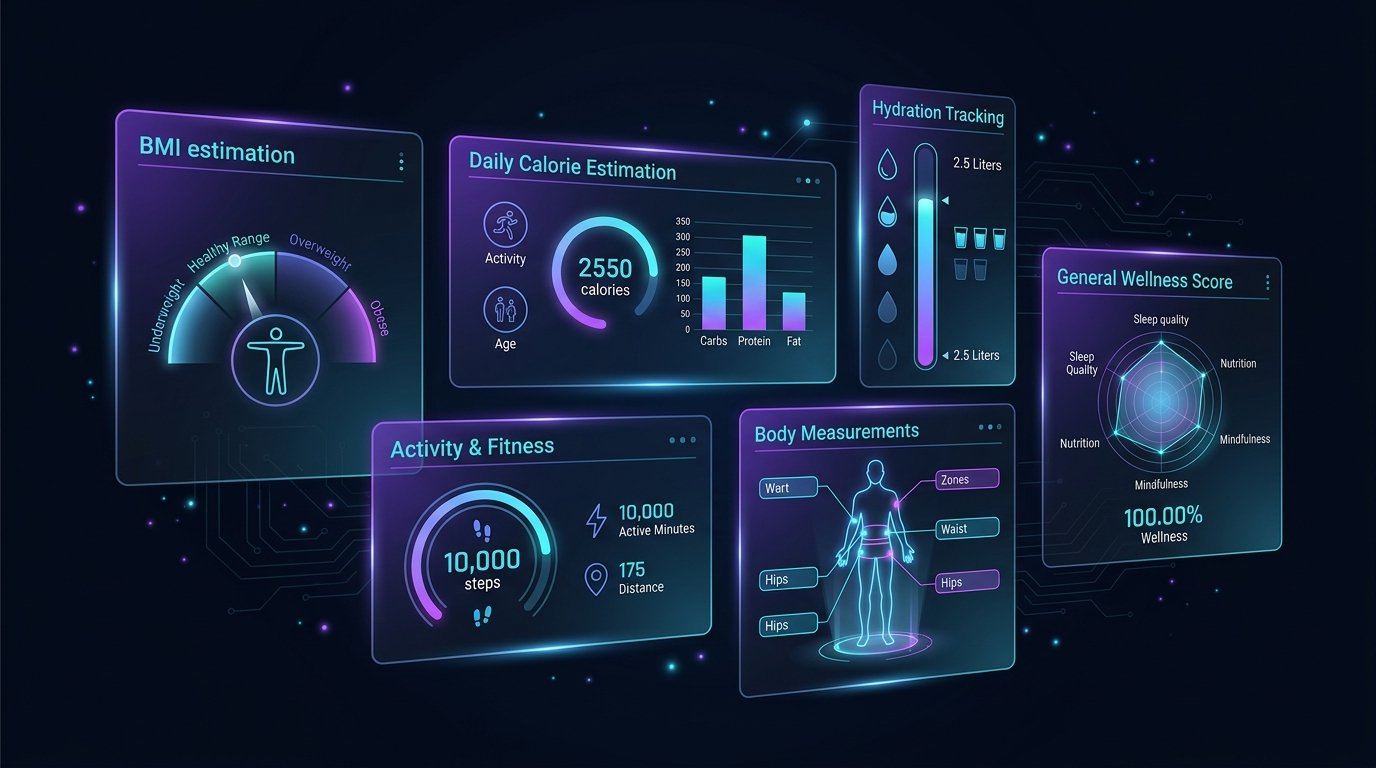
Online Health Calculators can provide quick estimates for measurements such as body mass index, daily calorie needs, and general water intake. These tools can be useful for learning, planning, and understanding basic health-related numbers.
However, calculator results are estimates—not diagnoses, prescriptions, or personalized medical advice. Two people with similar calculator results can have very different health circumstances, activity levels, body composition, medications, environmental conditions, or nutritional needs.
The best way to use health calculators is to understand what each result represents, recognize its limitations, and seek qualified medical advice when an individual health decision requires it.
This beginner-friendly guide explains how BMI, calorie, and water-intake calculators work and how to interpret their results responsibly.
What Are Online Health Calculators?
Online Health Calculators are digital tools that use formulas and user-provided information to produce health-related estimates.
Depending on the calculator, inputs may include:
- Age
- Sex
- Height
- Weight
- Activity level
- Other basic measurements
Common examples include:
Because these tools rely on formulas and limited inputs, they cannot capture every factor affecting an individual’s health.
Think of the result as information—not a medical conclusion.
Why Use Online Health Calculators?
Health calculations can be inconvenient to perform manually.
For example, BMI requires height and weight to be combined using a specific formula.
Calorie estimation may involve an equation followed by an activity multiplier.
A browser-based calculator can perform these steps instantly.
This can help you:
- Understand basic measurements
- Compare general estimates
- Learn how formulas work
- Track broad changes over time
- Prepare questions for a qualified professional
The value of the calculator depends on understanding what it can—and cannot—tell you.
Step 1: Choose the Correct Calculator
Start by identifying what you want to estimate.
If you want a basic weight-to-height screening measure, use a BMI Calculator.
If you want a general estimate of daily energy needs, use a Daily Calorie Calculator.
If you want a general hydration estimate, use a Water Intake Calculator.
Do not treat the output from one tool as though it answers a different health question.
Step 2: Enter Information Carefully
A calculator can only work with the information you provide.
Check values before calculating.
Common input mistakes include:
- Entering pounds as kilograms
- Entering inches as centimeters
- Typing the wrong age
- Selecting the wrong activity level
- Entering an incorrect height
Unit errors can substantially change the result.
Review the form before interpreting any number it produces.
Step 3: Understand BMI
BMI stands for Body Mass Index.
For adults, the metric formula is:
BMI = Weight in kilograms ÷ Height in meters²
For example, if a person weighs 70 kg and is 1.75 meters tall:
BMI = 70 ÷ (1.75 × 1.75)
which is approximately:
22.9
The calculation itself is straightforward.
The interpretation requires more care.
Step 4: Use a BMI Calculator
A BMI Calculator can perform the formula automatically.
Enter the requested:
- Height
- Weight
and calculate the result.
BMI is commonly used as a screening measure, but it is not a diagnosis of an individual’s health.
It does not directly measure body fat and does not distinguish between weight from muscle, fat, bone, and other body components.
Step 5: Understand BMI Limitations
BMI can be useful at a population level and as one screening measure, but it has important limitations for individuals.
It does not directly account for factors such as:
- Muscle mass
- Body composition
- Fat distribution
- Pregnancy
- Some age-related differences
- Individual medical circumstances
A muscular person, for example, can have a relatively high BMI without having the same body composition as another person with the same BMI.
Therefore, do not use a BMI result alone to diagnose yourself or another person.
For additional information about BMI and its role as a screening measure, review the CDC’s BMI guidance.
Step 6: Understand Daily Calorie Estimates
Your body uses energy continuously.
Daily calorie needs can vary based on factors including:
- Age
- Sex
- Body size
- Activity
- Individual physiology
- Life stage
- Health circumstances
Calorie calculators generally estimate energy requirements using established equations and assumptions.
The result should be treated as a starting estimate rather than an exact daily requirement.
Step 7: Use a Daily Calorie Calculator
A Daily Calorie Calculator may ask for:
- Age
- Sex
- Height
- Weight
- Activity level
The calculator first estimates basic energy needs using its programmed formula and may then adjust the estimate based on activity.
For example, a person who is highly active generally requires more energy than a similar person who is sedentary.
But activity categories are broad.
Two people selecting the same activity level may still have different actual energy needs.
Step 8: Understand BMR and TDEE
Two terms often appear in calorie calculations.
BMR — Basal Metabolic Rate
This estimates the energy required for basic physiological functions at rest.
TDEE — Total Daily Energy Expenditure
This estimates total daily energy use after accounting for activity through the calculator’s assumptions.
A simplified workflow is:
Personal Inputs → BMR Estimate → Activity Adjustment → TDEE Estimate
Neither number should be interpreted as a perfectly measured value for an individual.
Step 9: Avoid Extreme Calorie Changes Based on a Calculator
A calorie estimate should not automatically become a strict eating target.
Individual nutritional needs can depend on many factors that a simple calculator cannot assess.
Avoid making extreme dietary changes solely because an online calculator produced a particular number.
This is especially important for children, adolescents, pregnant or breastfeeding people, people with medical conditions, people with a history of disordered eating, and anyone with specialized nutritional needs.
For individualized nutrition advice, consult an appropriately qualified healthcare professional.
Step 10: Understand Water Intake Estimates
Water is essential, but hydration needs are not identical for everyone.
Requirements can vary with:
- Activity
- Temperature
- Humidity
- Diet
- Body size
- Pregnancy or breastfeeding
- Illness
- Medications
- Individual health conditions
A Water Intake Calculator can provide a general estimate based on limited information.
It cannot measure your exact hydration requirement.
Step 11: Use a Water Intake Calculator
Enter the information requested by the calculator.
Depending on its design, the tool may use body weight or other basic inputs to generate an estimated daily amount.
Use the result as general educational guidance.
Do not force yourself to consume an exact quantity simply because a calculator produced it.
Your circumstances may require more or less fluid.
Step 12: Remember That Fluids Can Come From Different Sources
Hydration is not necessarily determined only by glasses of plain water.
Fluid can also come from:
- Other beverages
- Foods with high water content
- Meals
The contribution varies with diet.
Therefore, a calculator output should not always be interpreted as an additional amount of plain water that must be consumed on top of every other source.
Step 13: Know That More Water Is Not Always Better
Excessive water consumption can be harmful.
Drinking very large quantities over a short period can disrupt the body’s electrolyte balance and may become medically dangerous.
This is another reason not to treat a generic calculator number as a target that must be exceeded.
People with kidney, heart, liver, endocrine, or other conditions affecting fluid balance should follow advice from their healthcare professional rather than generic hydration calculations.
Step 14: Use Online Health Calculators as Estimates
The most important rule for Online Health Calculators is simple:
Estimate ≠ Diagnosis
A calculator processes a limited set of inputs using a predefined formula.
It cannot:
- Perform a physical examination
- Review your complete medical history
- Interpret laboratory tests
- Understand all medications
- Diagnose disease
- Replace professional clinical judgment
Use calculators to learn and estimate—not to diagnose.
Step 15: Compare Results Carefully
You may notice that two health calculators produce slightly different results.
This does not necessarily mean one is broken.
Possible reasons include:
- Different formulas
- Different rounding
- Different activity multipliers
- Different assumptions
- Different input options
Check whether each tool explains its methodology.
Small differences can be normal when the underlying formulas differ.
Step 16: Track Trends Without Obsessing Over Numbers
Some people use calculators periodically to observe broad changes.
If you do this, try to focus on meaningful trends rather than small daily fluctuations.
Body weight, hydration, activity, and other measurements can vary naturally.
A calculator number is only one piece of information.
Health and fitness should not be reduced to a single score.
Step 17: Protect Your Privacy
Before entering health-related information into an online service, consider how the tool handles data.
Simple browser-based calculators can potentially perform calculations locally without sending inputs to an external server, depending on their implementation.
Avoid unnecessarily entering:
- Medical records
- Diagnosis details
- Prescription information
- Identification numbers
- Other sensitive personal information
A basic BMI or calorie calculation usually does not require detailed medical history.
Step 18: Know When a Calculator Is Not Enough
Seek qualified medical advice when you need individualized guidance or when symptoms, medical conditions, medications, pregnancy, eating concerns, or other circumstances affect your needs.
A calculator is particularly inappropriate as the sole basis for urgent or serious health decisions.
If you have concerning or severe symptoms, use appropriate medical services rather than waiting for an online calculator to provide an answer.
Step 19: Use Results to Ask Better Questions
One useful role for calculators is helping you understand terminology before speaking with a professional.
For example, after seeing a BMI result, you might ask:
“What are the limitations of BMI for my body composition?”
After receiving a calorie estimate:
“How should my activity and health circumstances affect my energy needs?”
This turns a generic calculation into a starting point for a more informed conversation.
Step 20: Review Your Inputs Before Saving Results
Before recording or comparing calculator results, check the inputs again.
Make sure:
- Units are correct
- Height is correct
- Weight is correct
- Age is correct
- Activity selection is reasonable
Incorrect inputs can make comparisons meaningless.
If you are tracking results over time, use consistent measurement methods where practical.
Online Health Calculators: A Simple Workflow
A responsible workflow is:
Choose Calculator → Enter Basic Information → Check Units → Calculate → Understand the Formula → Read Limitations → Interpret as an Estimate → Consider Personal Context → Seek Professional Guidance When Needed
The calculation itself may take seconds.
Understanding its limitations is what makes the result useful.
BMI vs Calorie vs Water Intake Calculators
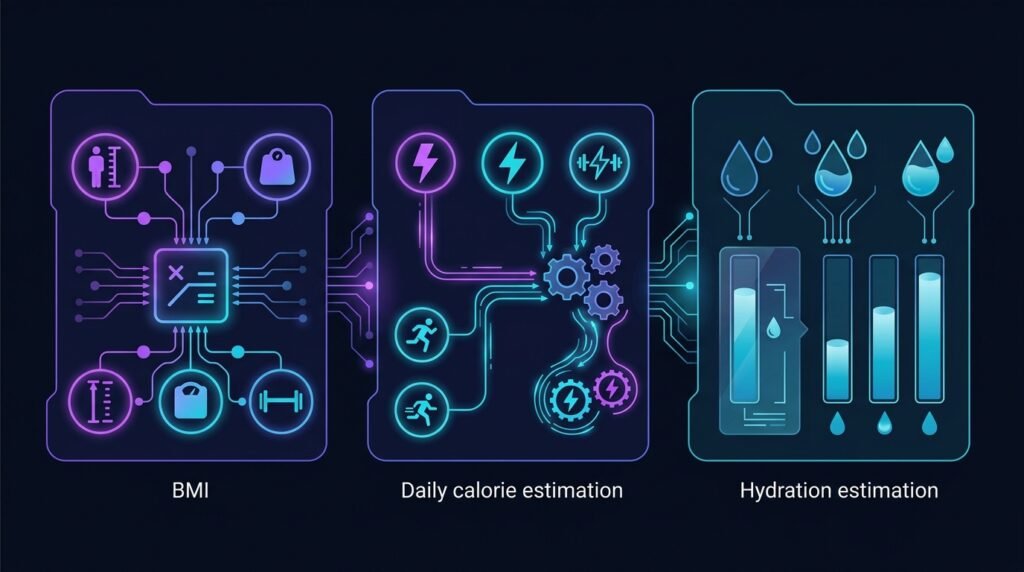
These three tools answer different questions.
BMI Calculator
Provides a weight-to-height screening measure.
Daily Calorie Calculator
Estimates daily energy requirements based on a formula and selected inputs.
Water Intake Calculator
Provides a general hydration estimate based on its programmed assumptions.
One result should not be used to validate another.
For example, a BMI result does not determine someone’s precise calorie or hydration requirements.
Online Health Calculators vs Professional Assessment
Online tools offer:
- Speed
- Convenience
- Basic education
- General estimates
Qualified healthcare professionals can consider much broader information, including medical history, symptoms, examinations, tests, medications, individual goals, and other relevant circumstances.
The two should not be treated as equivalent.
Use the calculator for the limited task it is designed to perform.
Common Health Calculator Mistakes
Common mistakes include:
- Entering incorrect units
- Treating BMI as a diagnosis
- Treating calorie estimates as exact prescriptions
- Forcing excessive water intake
- Ignoring medical conditions
- Making extreme dietary changes
- Comparing results from different formulas without context
- Obsessing over small numerical changes
- Sharing unnecessary health information online
- Assuming one number represents overall health
Understanding limitations is just as important as understanding the calculation.
Frequently Asked Questions
Are online health calculators accurate?
They can correctly apply their programmed formulas, but the resulting values are estimates based on limited inputs and assumptions. They do not measure every factor affecting an individual’s health.
Is BMI a diagnosis?
No. BMI is a screening measure based on height and weight. It does not directly measure body fat or diagnose a health condition.
Is a calorie calculator result exact?
No. Calorie calculators provide estimates. Actual energy needs vary between individuals and can change over time.
How much water should I drink every day?
Hydration needs vary with factors such as activity, climate, diet, health, medications, pregnancy, and individual physiology. A calculator can provide a general estimate but not a universal prescription.
Final Thoughts
Online Health Calculators can help you understand basic health and fitness measurements when they are used appropriately.
A BMI Calculator can provide a simple weight-to-height screening value.
A Daily Calorie Calculator can estimate energy requirements.
A Water Intake Calculator can provide general hydration guidance.
None of these tools can diagnose health conditions or determine every individual’s exact needs.
Check your inputs, understand the formula, read the limitations, and treat the output as an estimate.
For personalized medical or nutritional decisions, use appropriately qualified professional guidance rather than relying solely on an online calculation.