

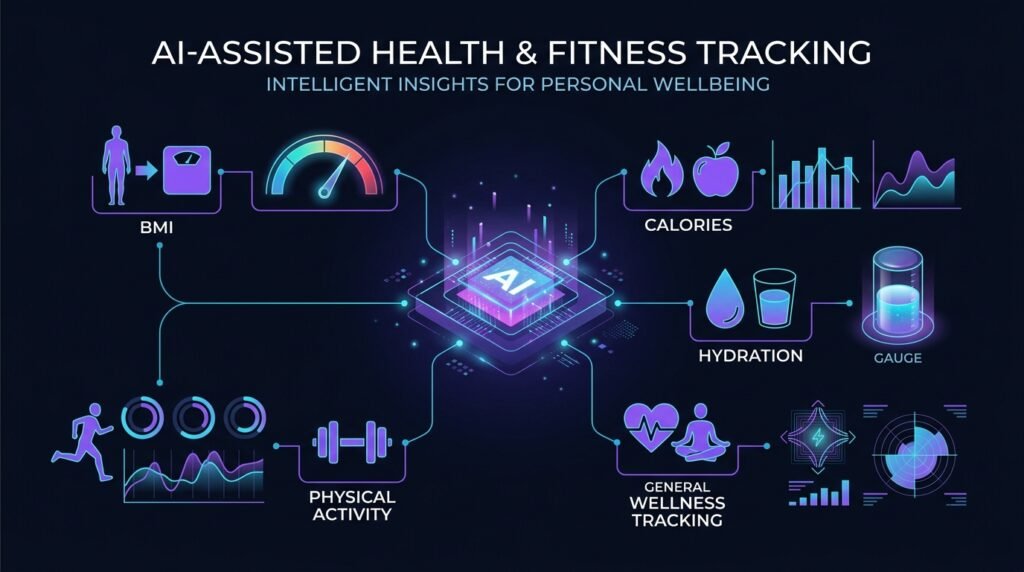
Using AI for health and fitness can help you organize wellness goals, understand general fitness concepts, plan routines, track habits, and make sense of basic information such as calories, BMI, and daily water intake.
AI can be useful for education and organization, but it should not be treated as a doctor, dietitian, or other healthcare professional. AI-generated health information can be incomplete, inaccurate, or unsuitable for an individual’s circumstances.
The safest approach is to use AI for general educational support while relying on qualified healthcare professionals for medical concerns, diagnoses, treatment decisions, or personalized health advice.
This beginner-friendly guide explains practical ways to use AI as part of a general health and fitness workflow.
What Is AI for Health and Fitness?
AI for health and fitness means using artificial intelligence tools to assist with general wellness-related information and organization.
Depending on the tool, AI may help you:
- Organize fitness goals
- Create workout ideas
- Understand exercise terminology
- Create general meal-planning ideas
- Track habits
- Organize progress notes
- Explain basic fitness concepts
- Create activity checklists
- Understand general calorie concepts
- Learn about hydration
- Prepare questions for a healthcare professional
These uses are primarily educational and organizational.
AI does not know your complete medical history, current health status, medications, laboratory results, or other factors that may affect what is appropriate for you.
Why Use AI for Health and Fitness?
Health and fitness information can become complicated quickly.
Beginners may encounter unfamiliar terms related to nutrition, exercise, calories, body composition, hydration, recovery, and physical activity.
AI can explain these concepts in simpler language.
For example, instead of searching separately for explanations of calories, energy expenditure, and activity levels, you could ask AI to explain how these concepts relate to each other at a general level.
The information can help you understand a topic before exploring authoritative sources or speaking with an appropriate professional.
Step 1: Define a General Wellness Goal
Start by identifying what you want to accomplish.
Examples might include:
- Becoming more physically active
- Building a consistent walking routine
- Improving sleep habits
- Organizing meals
- Tracking water intake
- Learning basic nutrition concepts
- Understanding fitness terminology
Keep medical goals separate from general productivity-style wellness planning.
For example, AI can help create a checklist for building a consistent walking habit.
If you have symptoms, injuries, medical conditions, or concerns about whether an activity is safe for you, appropriate professional guidance is more suitable.
Step 2: Use AI to Understand Fitness Terminology
Fitness information often contains terminology that can be confusing for beginners.
You can ask AI to explain terms such as:
- Cardiovascular exercise
- Strength training
- Repetitions
- Sets
- Recovery
- Mobility
- Calories
- Energy expenditure
For example:
“Explain the difference between cardiovascular exercise and strength training in simple language for a beginner.”
This can make educational material easier to understand.
For important health information, verify the explanation with reliable health organizations.
Step 3: Create a Simple Activity Plan
AI can help organize general activity ideas into a schedule.
For example:
“Create a simple weekly activity planning template with spaces for walking, strength activities, mobility, and rest. Do not provide medical advice.”
You can then adapt the structure according to your circumstances and professional recommendations where relevant.
The purpose is organization rather than personalized medical exercise prescription.
Step 4: Understand BMI
Body Mass Index, or BMI, is a screening measure based on a person’s weight relative to height.
A BMI Calculator can perform the mathematical calculation quickly.
However, BMI has important limitations.
It does not directly measure body fat and does not fully account for factors such as muscle mass, body composition, age-related differences, pregnancy, or individual health circumstances.
Therefore, BMI should not be treated as a diagnosis or a complete assessment of someone’s health.
A healthcare professional can interpret body measurements alongside other relevant health information when necessary.
For more information about BMI and its use as a screening measure, you can review the CDC’s official guidance on Body Mass Index.
Step 5: Understand Daily Calorie Estimates
The body uses energy throughout the day for basic biological functions and physical activity.
Various formulas can estimate daily energy requirements using information such as age, sex, height, weight, and activity level.
A Daily Calorie Calculator can provide a general estimate based on the values entered.
The result is not an exact measurement of how many calories an individual must consume.
Actual energy needs can vary because of body composition, activity, physiology, health conditions, pregnancy, breastfeeding, medications, and other factors.
Treat calculated results as general informational estimates rather than personalized dietary prescriptions.
Step 6: Learn About Hydration
Water is essential for normal body functions.
Hydration needs vary between individuals and can be affected by factors such as activity, climate, diet, pregnancy, illness, and other circumstances.
A Water Intake Calculator can provide a general estimate based on its underlying assumptions.
However, there is no single amount that is appropriate for everyone in every situation.
People with certain medical conditions or specific fluid requirements should follow guidance from their healthcare professional rather than relying on a general online calculator.
Step 7: Use AI for General Meal Planning Ideas
AI can help organize general meal ideas.
For example:
“Create a seven-day template for planning breakfast, lunch, dinner, and snacks. Leave spaces for me to enter my own foods.”
You can also ask for general educational information about food groups or meal organization.
Be cautious about asking AI to prescribe restrictive diets, diagnose nutritional deficiencies, or create treatment plans for medical conditions.
Individual nutrition requirements can vary significantly.
For personalized dietary advice, an appropriately qualified nutrition professional may be more suitable.
Step 8: Create a Habit Tracker
Health-related goals often depend on consistency.
AI can help create a simple habit tracker containing activities such as:
- Walking
- Exercise
- Sleep routine
- Meal planning
- Water tracking
- Stretching
- Screen breaks
You can choose which habits are relevant to you.
A tracker does not need to be complicated.
The objective is simply to make consistent behaviors easier to observe over time.
Step 9: Use AI to Organize Fitness Notes
If you keep notes about workouts or general wellness activities, AI can help organize them.
For example:
“Organize these workout notes into date, activity, duration, and observations.”
Avoid unnecessarily including sensitive medical information.
If the information contains personal health details, consider whether an AI service needs that information to complete the task.
Often, generic or anonymized information is sufficient.
Step 10: Create Better Questions for a Professional
AI can help you prepare questions before an appointment with a qualified professional.
For example:
“Create a list of general questions I could ask a fitness professional before starting a new exercise program.”
This can help you organize your thoughts.
However, AI should not answer on behalf of the professional when the question requires individualized medical assessment.
The purpose is preparation, not replacement.
Step 11: Be Careful With Symptoms and Diagnoses
AI should not be relied upon to diagnose symptoms.
Many health conditions can share similar symptoms, and proper assessment may require medical history, physical examination, testing, or other clinical information.
If you are experiencing concerning or persistent symptoms, seek appropriate medical care.
For urgent or severe symptoms, use the emergency medical services available in your location.
Do not delay necessary medical care because an AI-generated response appears reassuring.
Step 12: Avoid Using AI to Change Medication
Medication decisions require particular care.
Do not use AI-generated information as the sole basis for starting, stopping, changing, or adjusting prescription medication.
Questions about medication dosage, interactions, side effects, or treatment plans should be discussed with an appropriate healthcare professional or pharmacist.
AI can potentially help explain general terminology, but medical decisions require reliable individualized guidance.
Step 13: Protect Your Health Information
Health information can be highly personal.
Avoid unnecessarily sharing:
- Medical record numbers
- Insurance identifiers
- Full medical records
- Prescription identifiers
- Personal identification numbers
- Private account credentials
- Other identifying health information
Before entering health-related information into any digital service, consider whether the information is actually required.
Using generic examples can often provide the educational explanation you need without exposing private details.
Step 14: Verify Health Information
AI can generate information that sounds convincing but is incorrect or outdated.
For general health information, compare important claims with trustworthy sources such as government health agencies, recognized medical organizations, or qualified professionals.
This is particularly important for information involving:
- Disease
- Medication
- Nutrition
- Pregnancy
- Children
- Supplements
- Injuries
- Treatment
- Medical procedures
The higher the potential consequence of being wrong, the more important verification becomes.
Step 15: Use AI to Build Sustainable Routines
AI can help turn a broad wellness goal into smaller organizational steps.
For example, instead of:
“Make me healthy.”
try:
“Help me create a simple weekly checklist for walking, meal planning, sleep consistency, and taking regular breaks from my desk.”
This creates a practical structure without asking AI to diagnose or treat anything.
A sustainable routine should also fit your actual schedule and circumstances.
If a plan is too complicated to follow consistently, simplifying it may be more useful than adding more tasks.
AI for Health and Fitness: A Simple Workflow
A responsible beginner workflow could look like:
Goal → General Information → AI Organization → Calculator or Tracking Tool → Review → Verify Important Information → Professional Guidance When Needed → Adjust Routine
Begin with a general wellness objective.
Use AI to understand concepts and organize information.
Use appropriate calculators or tracking tools for basic estimates.
Review the results and verify anything important.
When a decision involves medical conditions, symptoms, treatment, medication, or individualized dietary requirements, seek appropriate professional guidance.
AI Health Tools vs Simple Calculators
AI and health calculators perform different roles.
AI is useful for explaining general concepts, organizing information, and creating templates.
A dedicated calculator performs a specific calculation according to its formula.
For example, a BMI Calculator calculates BMI from the information entered, while AI can explain what BMI generally represents and why it has limitations.
Similarly, a Daily Calorie Calculator can estimate energy needs according to its formula, while AI can explain the factors that may cause real requirements to differ.
Neither should be treated as a medical diagnosis.
Common Mistakes When Using AI for Health
One of the biggest mistakes is treating general AI information as personalized medical advice.
Another is relying on an AI response to diagnose symptoms.
Users may also assume that calorie, BMI, or hydration estimates are precise requirements rather than general estimates.
Other problems include sharing unnecessary sensitive health information, following restrictive diet suggestions without appropriate guidance, or changing medication based on generated information.
AI can support health education and organization, but it should not replace appropriate healthcare.
Frequently Asked Questions
Can AI help with health and fitness?
AI can help explain general concepts, organize wellness goals, create templates, and assist with habit planning. It should not replace professional medical diagnosis or treatment.
Can AI create a workout plan?
AI can suggest general activity structures, but an appropriate exercise plan depends on individual circumstances. Medical conditions, injuries, pregnancy, age, and other factors may require professional guidance.
Are online calorie calculators accurate?
Calorie calculators provide estimates based on formulas and the information entered. Actual energy requirements vary between individuals.
Can AI diagnose health problems?
AI should not be relied upon for medical diagnosis. If you have symptoms or health concerns, seek advice from an appropriate healthcare professional.
Final Thoughts
Using AI for health and fitness can make general wellness information easier to understand and organize.
AI can help explain fitness terminology, create habit trackers, organize activity plans, and make general information more accessible.
Simple calculators can also provide useful estimates for BMI, calories, and hydration.
The key is understanding their limitations.
Use these tools for education and organization, protect sensitive information, verify important health claims, and involve qualified professionals whenever decisions require individualized medical guidance.